Builder Spotlight
Zeigler/Bailey’s Z/B 4.4, as told by DMARGE
Luc Wiesman, writing for DMARGE on 24 November 2026, visits Zeigler/Bailey in Melbourne and describes the Z/B 4.4 as an “heirloom” 911 — and as a $1.6 million car. Zeigler/Bailey itself does not publish a price.
- By
- DriveMarket Editorial
- Published
- November 24, 2026
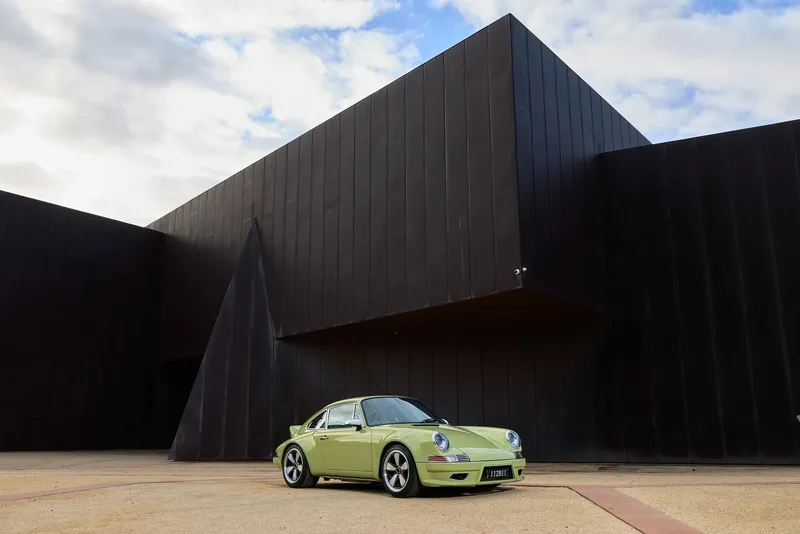
Luc Wiesman, writing for DMARGE on 24 November 2026, flew to Melbourne and drove down the Mornington Peninsula to spend a day with the Z/B 4.4, the car John Zeigler Jr and engineer Greg Bailey build together. The piece is framed around inheritance: Wiesman likens Zeigler’s idea to the famous Patek Philippe campaign, in which you never really own the watch, you just look after it for the next generation — “on four wheels,” he writes.
DMARGE describes the Z/B 4.4 as a “$1.6 million car” and, in its standfirst, as a “$1.6 million 911.” That figure is DMARGE’s, not a price published by Zeigler/Bailey on its own site, where commissions are invited without a stated figure. The article does not spell out a currency.
An heirloom, in the workshop
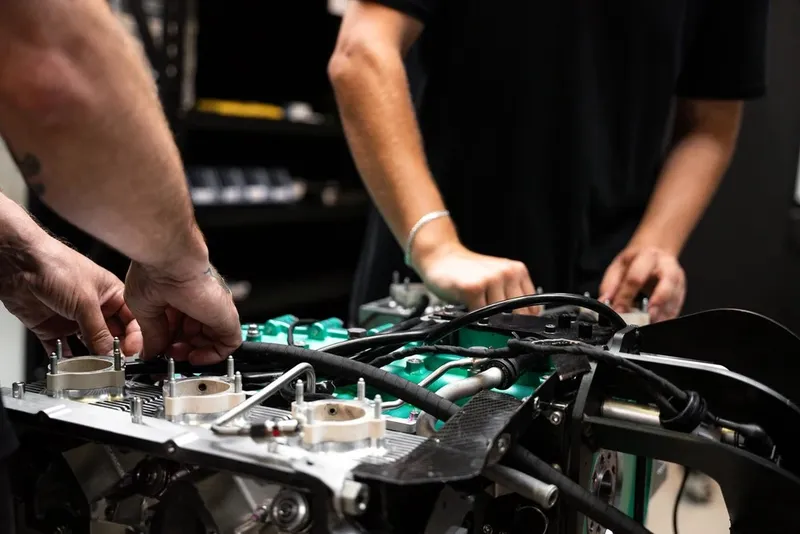
The part of Zeigler/Bailey that Zeigler is proudest of, Wiesman reports, has nothing to do with engineering. Owners are invited into the workshop to help build their own engine, and plenty of them bring their sons and daughters. “In the process they actually gesture and say, ‘I’m going to hand this down, it’s an heirloom,’” Zeigler tells him. “So the son or daughter all of a sudden assumes ownership. How are you going to sell the car you’ve already half handed down?”
Zeigler, Wiesman writes, did not want buyers who would keep a car for 12 months, flip it and end up competing with Zeigler/Bailey’s own pricing. Every Thursday, owners dial into an engineering update. “It’s not a car anymore. It becomes a discussion at the dinner table,” Zeigler says. One buyer, a woman who wants to build her car with her daughter, told him that experiences outlast the object. “If we can get that, we’re unique worldwide,” he says. “Nobody else does that.”
A new engine, not a rebuilt one
Before it was an heirloom, Wiesman writes, the Z/B 4.4 was a list: what Bailey loved and loathed about Porsches, and the same list from Zeigler, a classic Porsche collector. The partnership started during COVID, when Zeigler sat in a Melbourne workshop watching Bailey assemble a Ferrari Dino 246 GTS restoration. Five years later, DMARGE reports, there are nine cars in production: one original test mule, which the team took to the track and tried to break, and eight that are sold.
Bailey, Wiesman says, bristles a little at the word restomod. By Bailey’s count, Zeigler/Bailey re-engineers 80 per cent of the car: “a G-series 911 on the outside and a brand new car underneath.” The original plan was to restore and modify factory air-cooled engines, but no two 50-year-old engines had lived the same life, and turning them into performance engines would have meant throwing away about 75 per cent of the parts and still being stuck at roughly 3.5 litres. So they designed their own engine from a clean sheet.
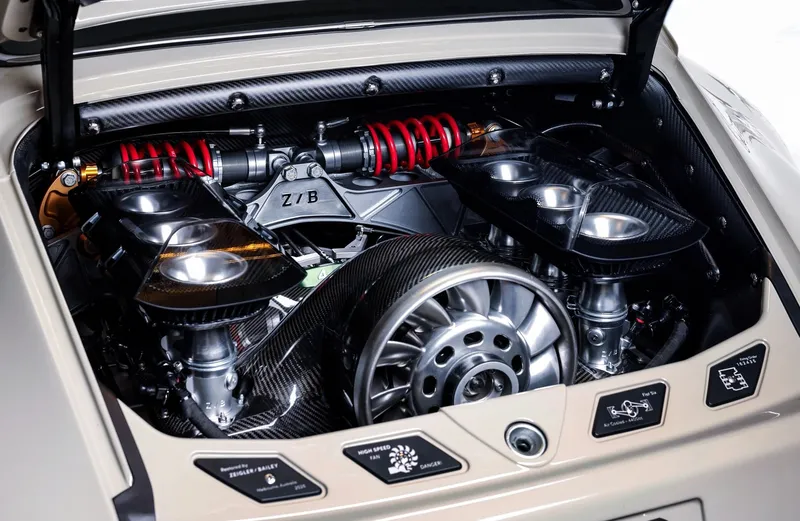
The result, which matches Zeigler/Bailey’s own published figures, is a 4.4-litre air-cooled flat six that the company says produces 300 kW and 500 Nm, with twin spark plugs per cylinder and fuel injection, and cooling split roughly 50/50 between air ducted through a carbon shroud and oil pumped to coolers up front — the cooling split is Wiesman’s reporting. Zeigler, in the piece, says it drives “like a V8,” with torque arriving low enough to make progress on a public road without screaming it.
What of the donor, and of the drive
Donor cars, Bailey tells DMARGE, “have to be G-series 911s from the galvanised era, roughly 1975 to the late ’80s.” That is slightly narrower than Zeigler/Bailey’s own site, which presents the Z/B 4.4 as a recommissioning of a 1974–1989 911 G-series. Not much of the donor makes it through, in Wiesman’s account: the roof and doors stay steel, because the doors need steel impact bars for Australian Design Rules; everything below the beltline becomes carbon fibre; and the floor pans are cut out and replaced with in-house pressings, which is what fixed the driving position.
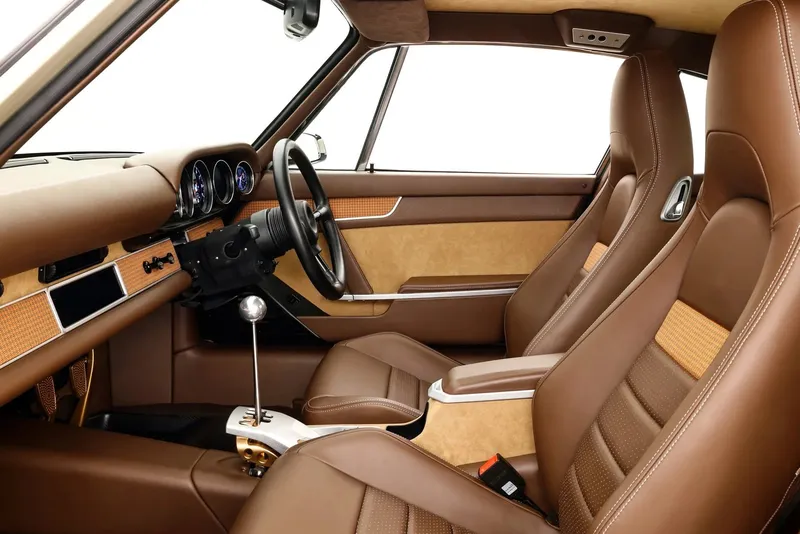
Wiesman also reports a 3D-printed exhaust with small catalytic converters and three mufflers to keep it under 90 decibels at 1.5 metres; 14-way electric seats from the 991-generation 911; a digital cluster with CarPlay that Bailey did not want looking like “some sort of Star Trek car”; an external oil filler as a nod to the 1972 911; and a manual gearbox from a 964-generation 911. The engine, Bailey says in the piece, would fit anything from a 1969 to an early-’90s 911, with some oil-line and oil-tank changes — a claim reported by DMARGE, not published as a programme specification on the builder’s site.
Zeigler/Bailey, Wiesman writes, wrote its own software so it can build five cars at once, and promises 12 months from paint selection to delivery. After the launch the founders drove a car from Sydney to Melbourne the long way, through Bathurst, Canberra and the Snowies, then down the coast. Zeigler tells him he wants to give Australians something world-class that was built here, but not at volume: he would rather the cars sat “alongside Birkins and the hardest-to-get watches, where people fight for an allocation.”
On DriveMarket
Source
This is an own-words summary of “Zeigler/Bailey Wants To Be The Patek Philippe Of Custom Porsches”, by Luc Wiesman, published by DMARGE on 24 November 2026. Official specifications and the 1974–1989 G-series donor years are taken from Zeigler/Bailey’s Z/B 4.4 pages, where they differ from the article. Photographs are Zeigler/Bailey’s official images, not DMARGE’s. Porsche, 911 and G-series are trademarks of their respective owners and are used on DriveMarket for identification only. DriveMarket is not affiliated with Porsche AG or Zeigler/Bailey. Zeigler/Bailey states that it is independent of Porsche AG.