Jaguar
Jaguar XJS V12 HE (1981–1991) restomods
The Jaguar XJ-S was introduced in September 1975 with a 5.3-litre V12, at that time Jaguar’s most expensive production car, at £8,900. Intended as a prestige grand-touring coupé, it combined a top speed close to 150 mph (240 km/h) with comfort and refinement. The High Efficiency (H.E.) version of that V12, introduced …
- Make
- Jaguar
- Model
- XJS V12 HE (1981–1991)
- Years
- 1981–1991
- Builders
- TWR
History
According to the Jaguar Daimler Heritage Trust, the XJ-S was introduced in September 1975 with the 5.3-litre V12 engine, then Jaguar’s most expensive production car at £8,900. It was intended as a prestige grand-touring coupé, with sports-car performance — a top speed close to 150 mph (240 km/h) — and comfort and refinement to match. Its unconventional styling and lack of traditional wood veneer caused some concern at first, but over the years the XJ-S grew in reputation and, in the Trust’s account, became the most successful sporting car Jaguar had ever produced.
From 1983 a 3.6-litre AJ6 six-cylinder engine became available in a new cabriolet, later also offered with the V12. In 1988 the cabriolet was replaced by a convertible with a fully folding top. The XJ-S range went through a major restyling in 1991, and production of the wider line came to an end in April 1996, before the introduction of the XK8 later that year. Source: Jaguar Daimler Heritage Trust, account of the last XJ-S in the Trust’s vehicle collection.
The H.E. engine
In 1981 Jaguar introduced heavily revised High Efficiency (H.E.) versions of the 5.3-litre V12 across the range. Contemporary coverage in Motor Sport (August 1981) described the adoption of the “Fireball” combustion-chamber principles invented by Swiss engineer Michael May: a split-level chamber with the inlet valve in a shallow collecting zone, the exhaust valve higher in a bath-tub chamber, and a swirl-inducing ramped channel between them. As the piston rose, the mixture was pushed into the main chamber and swirled, allowing leaner mixtures and a higher compression ratio on 97-octane fuel.
Motor Sport recorded Jaguar’s aim of bringing V12 fuel economy into what Jaguar Daimler called the “psychologically important 20 m.p.g. bracket,” and quoted Department of Energy figures for the XJS H.E. of 27.1 mpg at 56 mph, 22.5 mpg at 75 mph and 15.6 mpg on the urban cycle. It also recorded an improved claimed top speed of 155 mph, and described the XJS H.E. as the world’s fastest automatic-transmission production car at that time. Source: Alan Henry, “Jaguar XJS H.E.,” Motor Sport, August 1981.
Production
The Jaguar Daimler Heritage Trust’s XJ-S research guide (RG001N, Issue 3, April 2020) dates the first H.E. engine car to February 1981, VIN 105048, and records the V12 H.E. as discontinued in March 1991, VIN 179733, described as the last pre-facelift VIN. The guide’s figures are given as approximate. The Trust states that the XJ-S was in production for twenty-one years, during which a total of 115,413 were made, and that production ended in April 1996. That total is for the entire XJ-S line, not a figure isolated to the V12 H.E. alone. Source: Jaguar Daimler Heritage Trust, Research Guide 001N, Jaguar XJ-S, Issue 3, April 2020.
Competition
The XJ-S also had a competition career. The Jaguar Daimler Heritage Trust records that it appeared in American races with the Group 44 team from 1976 to 1982, and that in 1984 Tom Walkinshaw won the European Touring Car Championship and, together with Win Percy, the Spa 24-hour race. Source: Jaguar Daimler Heritage Trust, account of the last XJ-S in the Trust’s vehicle collection.
Photographs
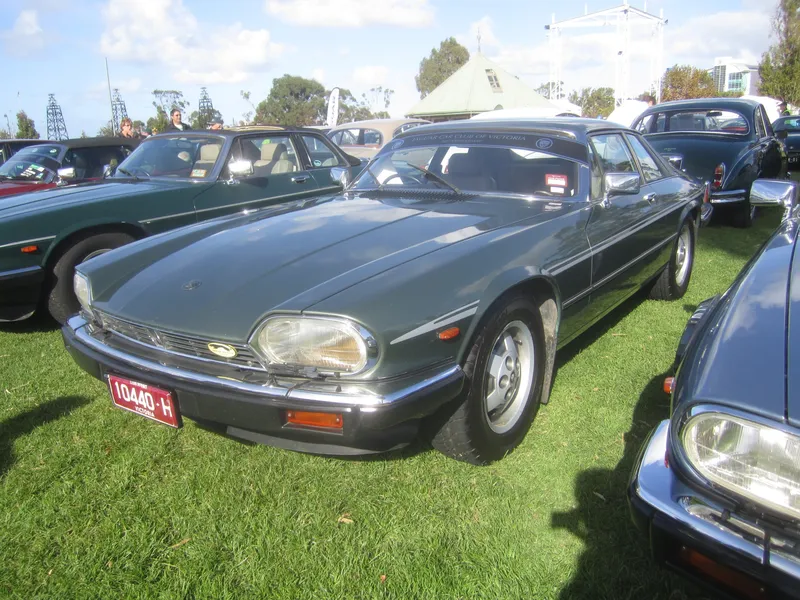
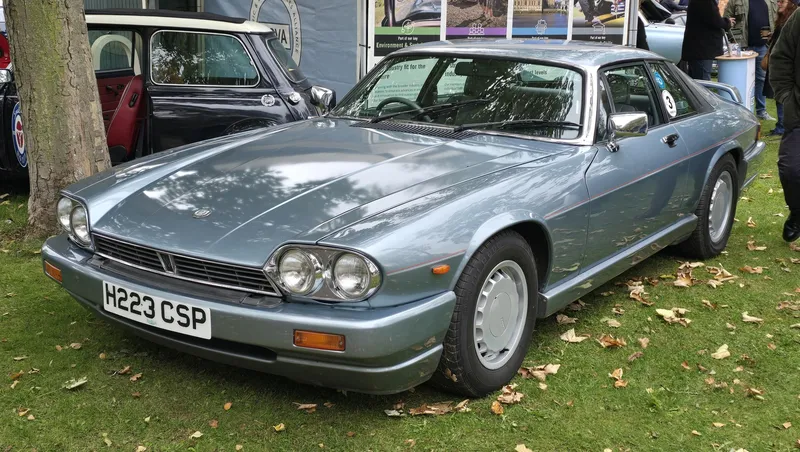
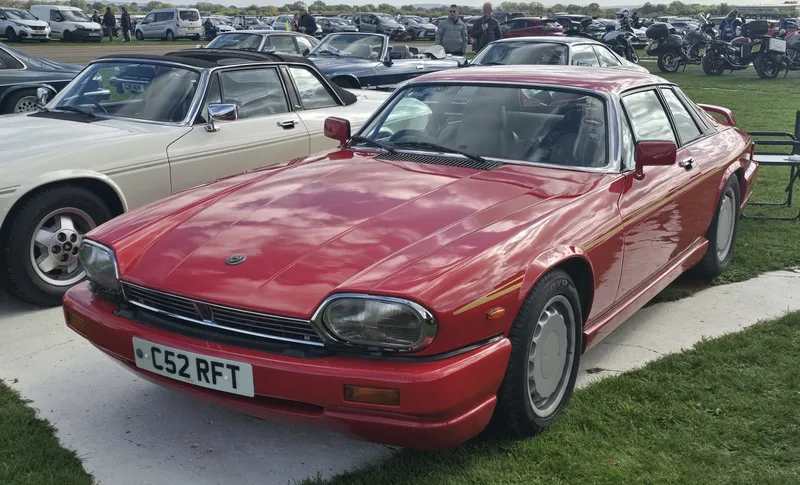
All photographs show stock production pre-facelift XJ-S coupés from the H.E. period, from Wikimedia Commons.
Hero: Jaguar XJS HE Auto 1985, photograph by Calreyn88, Wikimedia Commons, CC0.
1988 V12 coupé: 1988 Jaguar XJ-S V12 Coupe, photograph by Sicnag, Wikimedia Commons, CC BY 2.0.
1991 H.E.: 1991 Jaguar XJS HE, photograph by MrWalkr, taken at Bicester Scramble, Wikimedia Commons, CC BY-SA 4.0.
Photos